
Meta Performance Unlocked: What to Know
Thought Leadership
|November 16, 2026
If your Meta playbook hasn’t changed this year, it’s already behind. At Meta’s Performance Unlocked Workshop, some of the sharpest minds in media dug into what’s next for the platform and how to win the holiday rush. Some sessions spotlighted what’s new, while others reinforced what already works. Here are a few notes from our Meta playbook on what’s changing, what’s working, and what advertisers need to know to stay ahead of the competition in Q4 and beyond.
Meta is Creating More Tools. Advertisers Need to Learn How to Use Them.
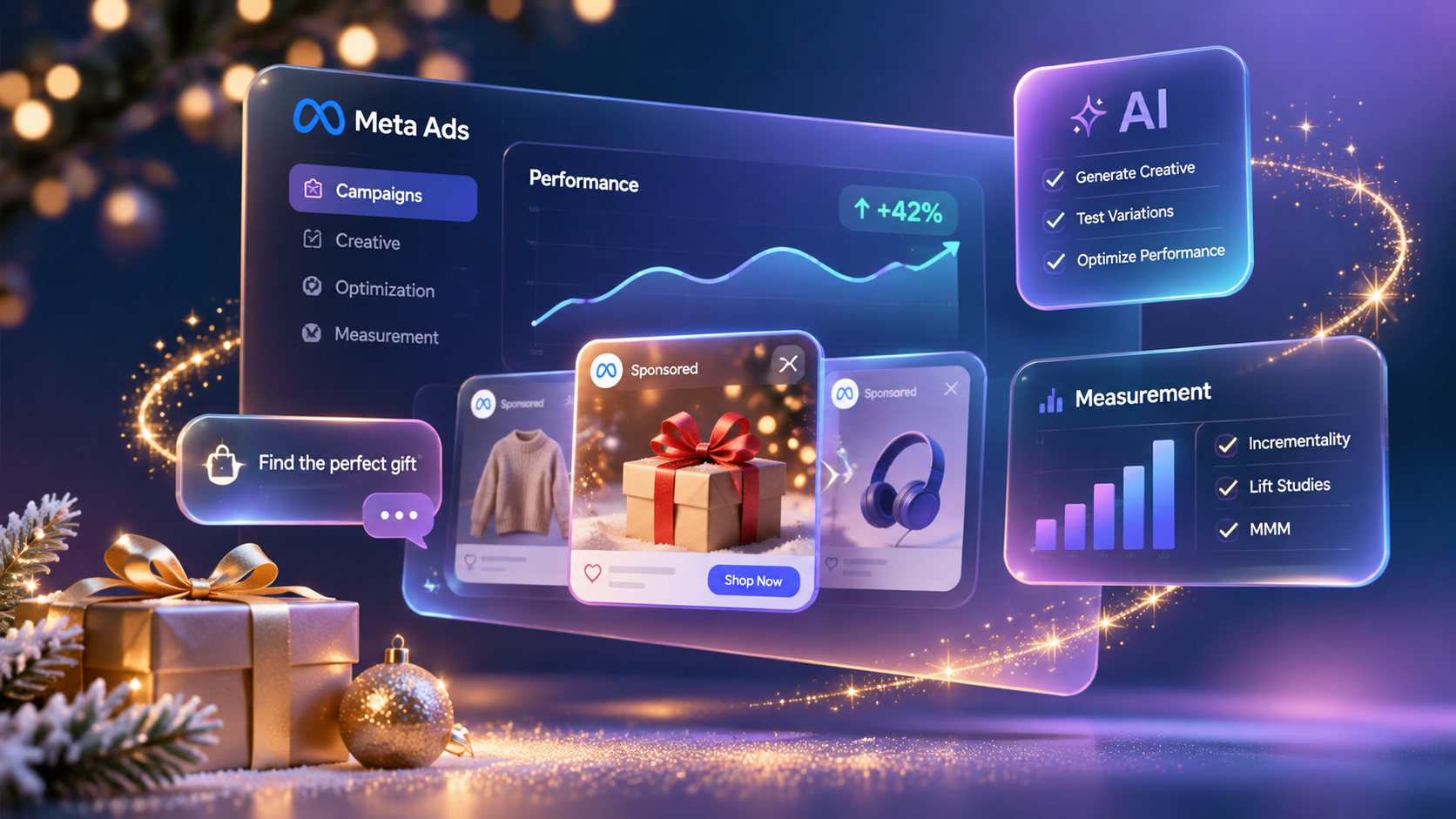
Meta’s push toward an AI-powered advertising ecosystem is reshaping nearly every aspect of paid media, from creative development and campaign optimization to measurement.
Advantage+ creative enhancements have rolled out at rapid fire speeds over the past year, with new settings and auto opt-ins keeping advertisers on their toes. Among the latest is Muse Image, an agentic model that uses text prompts and visual references to generate, edit, and create image variations. With Muse Video also underway, Meta is opening the door to unprecedented scale, with tools designed to interpret brand guidelines and preserve accuracy without manual rebuilds.
Additionally, creative management options have expanded with Ads Creative Studio, a new workspace that brings creative generation and performance insights together to identify creative fatigue, compare assets, and turn insights into new concepts all in one place.
Meta is also working to better connect ads and product sales with new retailer-focused tools for product level measurement and optimization. One example is Product Insights, a reporting tool that provides a breakdown of views, clicks, purchases, and ROAS by product. As Meta continues building in this direction, staying competitive may mean planning and optimizing around products as well as audiences, creative, and placements.
OUR TAKE: The real value isn’t more ads or more automation; it’s using these tools to optimize smarter. Use new reporting agents to reveal what’s resonating or losing momentum and identify opportunities faster, then test AI-powered production and enhancement tools to execute changes and optimize more efficiently. We’re not saying to try every new feature at once. Be selective about which tools you pull from the toolbox and when. Prioritize the biggest opportunities, test with a clear hypothesis, and prove the value before scaling.
Discovery is Becoming a Conversation.
Consumers are increasingly using AI to ask more specific questions about what to buy based on their needs, preferences, and budgets, with 45% of shoppers using AI assistants for purchase research. Meta is leaning into this shift with AI-powered shopping tools like Business Agent, which helps brands answer questions, recommend products, and guide purchases through personalized conversations on Messenger, WhatsApp, and Instagram.
OUR TAKE: For advertisers, that means the challenge is no longer just reaching the right person, but making sure AI has the right information to understand and recommend your brand in the first place. That starts with the fundamentals: accurate product catalogs, detailed product attributes, up-to-date pricing and availability, and consistent brand messaging. As AI increasingly helps consumers narrow their options, the quality of that information could determine whether a brand gets recommended or overlooked.
Sometimes the Best Optimization Is Leaving Your Campaign Alone.
With holiday competition driving up auction pressure, campaign stability becomes particularly important. And while Meta’s delivery algorithm continues to evolve, one fundamental principle hasn’t changed: the system needs time to learn what works. Significant edits to budgets, targeting, creative, or other settings can push ads back into learning when consistent delivery matters most.
OUR TAKE: The best time to optimize for the holiday rush is before it starts. Get campaigns built, tested, and out of the learning phase early, then avoid unnecessary changes when competition peaks. Here’s how:
⦁ Consolidate where possible: Eliminate unnecessary ad sets and audience fragmentation to concentrate optimization signals and accelerate learning.
⦁ Avoid unnecessary resets: Make any major structural and creative changes ahead of peak periods and avoid tweaking before results stabilize.
⦁ Scale strategically: Adjust budgets gradually to minimize disruption; as a general rule, no more than 20% at a time.
⦁ Give the algorithm time: Allow at least 7 days after launch or a significant change to evaluate performance.
⦁ Know when to step in: While stability matters, don’t let fear of restarting learning prevent necessary optimizations when performance calls for action.
Attribution Is Giving Us Less of the Full Story.
Today’s path to purchase is anything but linear. A customer may discover a brand through a creator, encounter a retargeting ad, search for the product days later, and ultimately convert through another channel. As the path to conversion becomes increasingly fragmented across channels and touchpoints, traditional attribution models struggle to capture the full picture.
Meta has found that last-click attribution can underestimate ad impact by 15–31%. That’s a significant blind spot for advertisers who use last-click as their north star to guide media investment. And even when multiple touchpoints are captured, attribution can’t always tell whether an ad caused the conversion or simply got credit for it.
OUR TAKE: Attribution still has a place in day-to-day optimization, but it shouldn’t be the only measure of success. It should be paired with reporting with tools like Marketing Mix Modeling, lift studies, and controlled experiments. As customer journeys grow more complex and automation more sophisticated, separating correlation from causation will only become more important. The goal isn’t just to determine which campaigns get credit, but to understand which investments are bringing incremental growth and where budgets can work harder.
The Bigger Picture.
Meta is giving advertisers more ways to create, optimize, and measure than ever, but having more tools doesn’t guarantee better results. The advantage comes from knowing which levers to pull, when to use them, and how each decision connects back to the larger strategy. As we close out the year, the challenge is balancing new opportunities with proven strategies. That means testing with purpose, giving campaigns room to perform, and looking beyond platform metrics to understand what’s driving results.
Related Articles

June 10, 2023
Thought Leadership
Entering the Entrepreneur Economy
U.S. new business applications were already on the rise before COVID-19. The upward trend in entrepreneurship has…

June 10, 2023
Thought Leadership
The Learning Stage of the Journey
The Learning Stage of the customer journey is incredibly important for consumers as they begin to shape their brain with new…

June 10, 2023
Thought Leadership
Differentiation in an Ocean of Agencies
There are 66,113 businesses in advertising, PR, and related services in the U.S. You need more than the promise of great…