

Don’t Underestimate the Consumer: The Reality Behind 2025’s “Disappointing” Holiday Retail Sales
Thought Leadership
Consumer Insights
Retail
|March 24, 2026
From the Wall Street Journal to Yahoo Finance, the headlines all said 2025’s holiday retail sales were flat and disappointing. Are consumers pulling back?
The data tells a different story. Let’s check out some graphs and run the numbers.
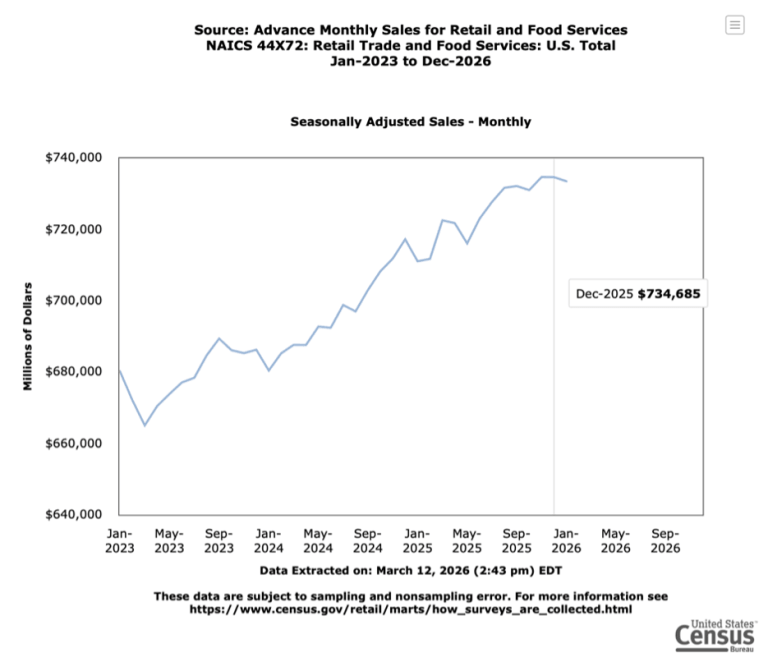
We’re going to unpack the “bad news” first. The disappointing sales figures come from seasonally adjusted retail sales. However, this type of data needs context.
Seasonal adjustment is a statistical technique that measures and removes predictable seasonal patterns to reveal underlying trends. In other words, this kind of data levels things out. It tells us what happens beyond normal expectations for a specific period. That’s great for month-to-month comparisons, but it can also miss the big picture.
Seasonally adjusted data tells us that consumers spent $735.085 billion in November and $734.967 billion in December of 2025. That’s right, it’s flat. Negative growth month to month if we’re being honest, but keep in mind, we are looking at “smoothed” data and not the actual holiday surge.
What did consumers actually spend?
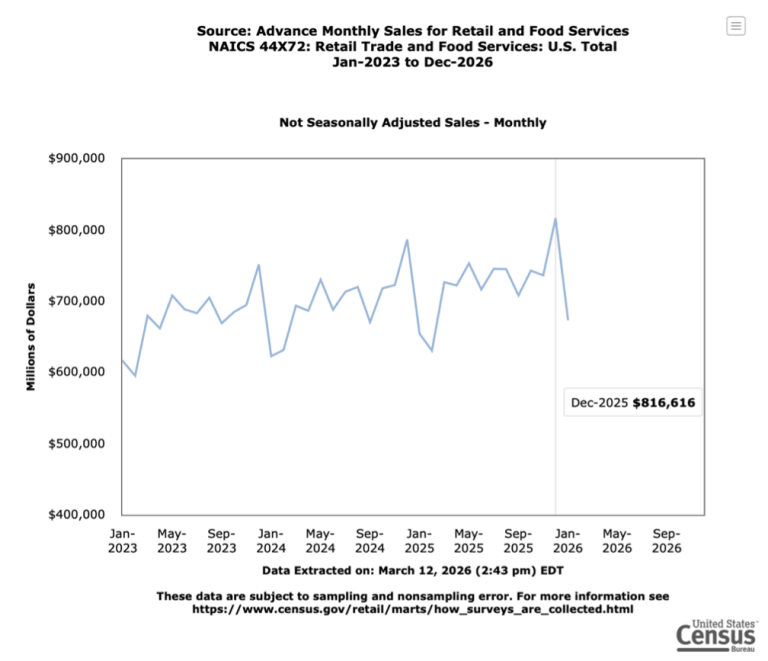
While seasonally adjusted month-to-month data looked flat, non-seasonally adjusted data tells a different story: consumers spent $736 billion in November and $817 billion in December of 2025. That’s an $80 billion dollar increase in retail sales. That translates to 11% holiday growth, up from 9% in 2024, and the trend holds even when 2024 sales are adjusted to 2025 dollars.
Let’s dive a little deeper with our non-seasonally adjusted data:
- YoY growth for the 2024 holiday season was 4.4% and 2025’s was 2.9%.
- November 2024 had 4% YoY growth and December’s was 4.7%.
- For 2025, November and December had 2% and 3.8% YoY growth respectively.
That’s a lot of numbers, but here’s the takeaway. The 2025 Holiday season had positive growth.
Is there a paradox between seasonally adjusted and non-seasonally adjusted data? What do we make of these two realities, and what does this tell us about consumers? On one hand we have poor expected performance for the holiday season, and on the other hand, we have the largest recorded increase in holiday retail sales in history. Consumers are spending more than ever, but not beyond expectations. This tells us that consumers are resilient and still strong. Consider what consumers have dealt with leading up to the holiday season: tariffs, slow job growth, and increasing inflation, resulting in shrinking consumer sentiment.
What’s powering the consumer and fighting off uncertainty? Wage growth.
Since the beginning of 2025 through September, average median wage growth has remained above 4% and only fallen to 3.7% in December. Compared with the inflation rate throughout 2025, which fluctuated but did not rise above 3%. Wages are growing faster than prices. This gives the consumer the ability to spend when sentiment is low, and uncertainty is high.
Now we’ve uncovered the truth behind the headlines and the paradox of contradicting data. This past holiday season didn’t break expectations, but it did break records. In an economy filled with uncertainty, don’t underestimate the consumer.
Related Articles

June 10, 2023
Thought Leadership
Entering the Entrepreneur Economy
U.S. new business applications were already on the rise before COVID-19. The upward trend in entrepreneurship has…

June 10, 2023
Thought Leadership
The Learning Stage of the Journey
The Learning Stage of the customer journey is incredibly important for consumers as they begin to shape their brain with new…

June 10, 2023
Thought Leadership
Differentiation in an Ocean of Agencies
There are 66,113 businesses in advertising, PR, and related services in the U.S. You need more than the promise of great…